
How to Boost IT Productivity: Strategies, Metrics, and Common Pitfalls (with Help from Lumos)
Aug 14, 2025
Learn how to boost IT productivity with practical strategies, meaningful metrics, and automation tools like Lumos. Discover how identity lifecycle automation reduces tickets, streamlines workflows, and helps IT teams operate at scale.
Last Updated
Sep 26, 2025


CIOs can’t prove what they can’t measure. According to Gartner research, 80% of CIOs now report to business leaders demanding visible results. The stakes are high: CIOs who can effectively demonstrate the business value of IT secure 60% more funding than those who can’t.
Ticket counts and time tracking often ignore “invisible work” like incident response, ad hoc troubleshooting, and maintaining legacy systems; tasks that can consume 30–40% of IT capacity. This inability to capture full value makes it tough to surface productivity gains or identify where real impact is being made.
Why IT Productivity Is Hard to Measure
Measuring IT productivity is far more complex than tracking output in traditional business functions. While other departments may rely on straightforward metrics like units produced or sales closed, IT teams operate in dynamic, service-driven environments where value is often indirect and outcomes are influenced by multiple interconnected factors.
Productivity in IT must account not only for project delivery and system uptime but also for ongoing maintenance, incident resolution, and lifecycle management of critical assets. This complexity is compounded by the fact that many IT contributions, such as preventing outages or improving security posture, are preventative and therefore harder to quantify. The following sections explore the limitations of conventional productivity metrics and the unique challenges IT teams face in managing and measuring performance across the service lifecycle.
The Limitations of Traditional Productivity Metrics
Teams are measured on uptime, automation coverage, and resolution speed – not on how many manual approvals they rubber-stamp. A team drowning in repetitive provisioning work might look “busy” but isn’t necessarily moving the business forward. Too often, IT leaders fail to identify and capture the business’s specific pain points, making it difficult to establish IT’s true value to the business.
Challenges Unique to IT Teams in Lifecycle Management
Lifecycle management touches every employee change: new hires, role moves, exits. Each event requires provisioning, access changes, and deprovisioning across dozens (or hundreds) of systems. Without automation, this means:
- Delays: Day 1 on-boarding slowed by manual approvals and lack of context into what applications and entitlements need to be provisioned for the new employees.
- Security gaps: Lingering access after role changes or offboarding, leaving gaps open for attackers to compromise.
- Ticket overload: Every move creates a wave of tickets for access requests and follow-ups, resulting in rubber-stamping or over-provisioned access.
Cross-functional dependencies with HR, GRC, security, and app owners compound the complexity, and without unified visibility, errors go unnoticed until audits or incidents force clean-up.
Lumos solves this by pairing full lifecycle automation with intelligent access controls, so the right access is granted instantly, updated in real time, and removed without delay.
How High Performers Improve IT Productivity
High-performing IT organizations understand that productivity is more than completing tickets or delivering projects – it’s about creating measurable business value. These teams bridge the gap between technical output and strategic outcomes by aligning their efforts with organizational priorities, often using identity and access management as a key enabler for secure, efficient operations. They also cultivate operational excellence through standardized processes, proactive problem-solving, and a culture of continuous improvement.
Linking IT Output to Business Outcomes via Identity
IT teams that drive automation and strong access governance can directly improve margins, security posture, and time-to-value. Lumos connects the dots: faster onboarding means employees contribute sooner, automated deprovisioning reduces risk, and license optimization cuts spend.
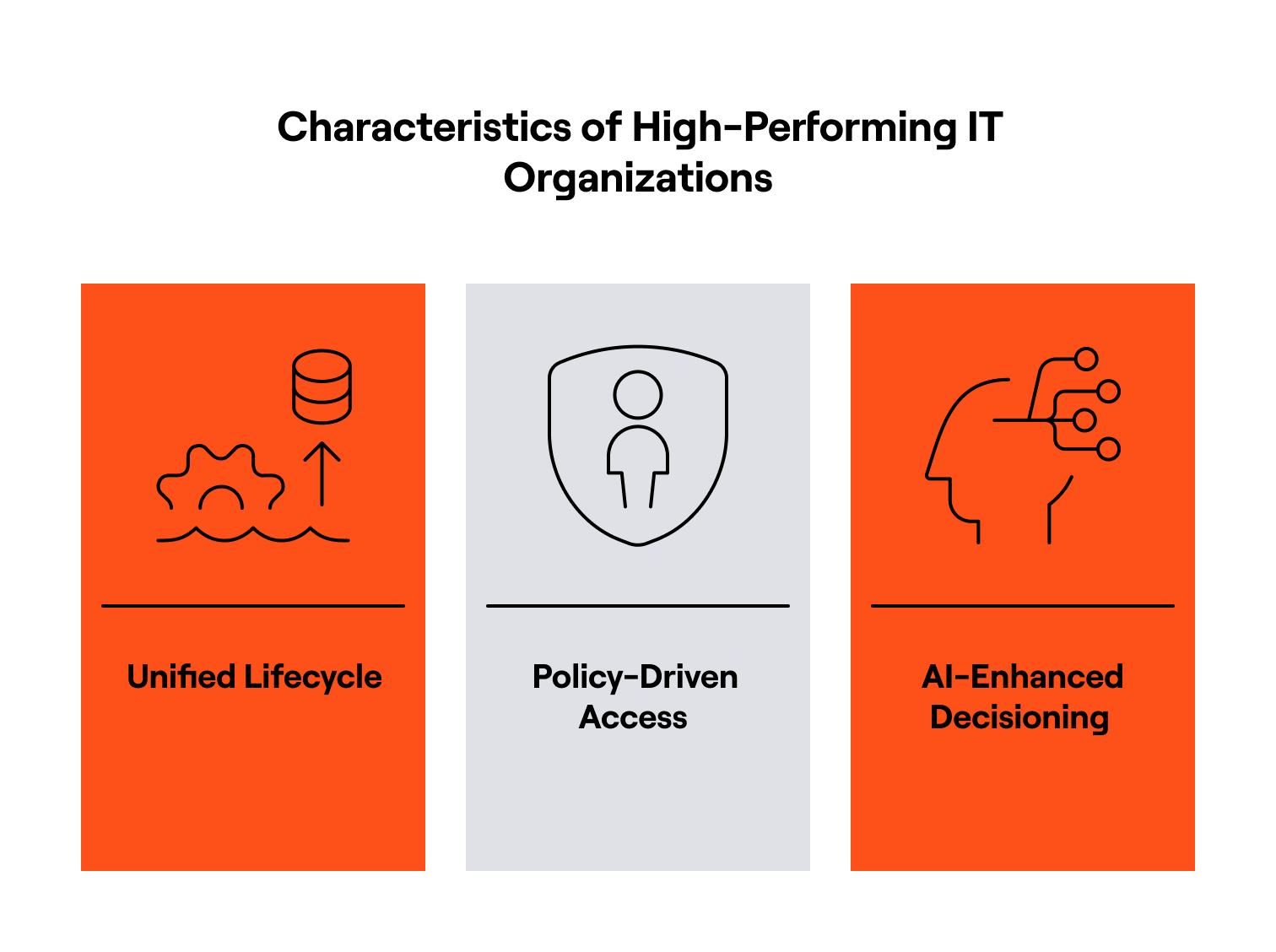
Characteristics of High-Performing IT Organizations
High-performing IT organizations often share similiar characteristics. These characteristics include:
- Unified lifecycle management across IT, security, and HR systems
- Policy-driven access controls (RBAC/ABAC) to enforce least privilege without bottlenecks
- AI-enhanced decisioning with Lumos Albus AI for real-time policy optimization
Strategies to Boost IT Productivity
Boosting IT productivity requires more than working harder; it demands smarter, more streamlined approaches that remove bottlenecks and maximize the value of every process.
High-impact strategies focus on automating routine lifecycle tasks, improving visibility across teams, and expanding integration coverage to eliminate manual handoffs. By aligning these improvements with business objectives, IT leaders can accelerate service delivery, reduce operational friction, and create a more agile, resilient technology environment.
Streamline Workflows with Automated Lifecycle Management
Identify where tickets pile up – manual provisioning, repeated approvals, stale reviews – and replace them with:
- Zero-touch onboarding that provisions all required access on Day 1
- Automated deprovisioning to close security gaps instantly
- Policy-based controls that update access as roles or attributes change
Improve Team Collaboration with Centralized Access Visibility
Breaking down silos between IT, security, and app owners is key to speeding up access decisions and reducing back-and-forth. Lumos centralizes access control, ensuring every stakeholder works from the same playbook:
- IT, security, and app owners align on shared workflows
- Employees request apps directly in Slack or Teams, reducing ticket handoffs
- The Lumos AppStore provides pre-approved, self-service access; no manual approvals needed for standard roles
Boost Automation and Integration Coverage for Speed
To scale IT productivity, repetitive identity tasks need to run in the background without manual intervention. Lumos’ automation and deep integrations make that possible:
- Automate license reclamation and reduce app sprawl
- Integrate with 300+ systems (HRIS, IdPs, SaaS, infra) for complete identity visibility
- Use Albus AI to refine roles and policies, reducing “access churn”
Metrics That Matter for IT Efficiency
When lifecycle management and access controls are automated, IT efficiency becomes measurable in ways that matter to the business – not just IT:
- Time-to-Access – With Lumos, approvals and provisioning happen in under 5 minutes for most requests, while JML events execute in real time.
- Automation Coverage – Lumos customers automate 70–90% of lifecycle events, freeing IT to focus on higher-value work.
- Risk Reduction – Automated deprovisioning and policy enforcement close access gaps instantly, reducing audit findings and compliance risk.
- Cost Optimization – License reclamation and usage tracking directly improve spend efficiency, often saving hundreds of thousands annually.
Using Structured Frameworks for Objective Vendor Selection
Selecting the right platform for lifecycle management and access controls is critical to achieving measurable IT productivity gains.
Use these frameworks to ensure your choice is data-driven, defensible, and aligned to business outcomes:
- Weighted Scorecard
- Outcome Heatmap
- KPI Dashboard Template
Weighted Scorecard
Build a scoring spreadsheet based on your Evaluation Criteria and Weights. During demos and PoC testing, score each vendor against every criterion, multiplying by weights to get a total, comparable score.
Tip: Align the scorecard with your defined success criteria and keep it transparent for stakeholders.
Outcome Heatmap
List your priority business outcomes: such as reduce audit time by X%, cut SaaS spend by Y%, automate onboarding in <1 day, govern AWS roles. Create a matrix showing how each vendor performed during the PoC against each outcome (High = Green, Medium = Yellow, Low = Red).
Tip: Involve both technical and business stakeholders when scoring outcomes – IT can validate functionality, while business owners confirm whether the vendor’s capabilities align with measurable ROI targets. This ensures your heatmap reflects not just technical fit, but real business impact.
KPI Dashboard Template
Pre-define post-implementation metrics to measure success and ROI. Baseline your current performance, then track improvement after rollout. Examples:
- % of applications under active governance (Reviews/JML)
- Standing privileged accounts (count vs. baseline)
- Average access request time-to-resolution (minutes/hours)
- Access-related IT tickets deflected per month
- Annual $ value of reclaimed licenses
- Average access review cycle time (days)
- Audit preparation time reduction (%)
- Employee onboarding time-to-productivity (days)
- Number of machine identities governed
Tip: Assign clear ownership for each KPI before deployment, and set automated reporting cadences (e.g., monthly or quarterly). This keeps performance tracking consistent, prevents metrics from going stale, and ensures accountability for achieving ROI targets.
By applying these structured frameworks, you move from subjective vendor selection to evidence-backed decisions – ensuring the platform you choose delivers measurable productivity gains long after go-live.
Common Pitfalls to Avoid
Even the most well-intentioned IT productivity initiatives can fall short if underlying challenges aren’t addressed. Some pitfalls are rooted in how productivity is defined and measured, while others stem from misaligned priorities between IT teams and the broader organization.
Recognizing these risks early helps leaders design strategies that drive meaningful, sustainable improvements.
The Productivity Paradox
More tools don’t always translate to more productivity. Fragmented ITSM, IGA, and SaaS management tools create more work, not less. Lumos consolidates these functions into a single automated platform, unifying lifecycle management and access governance so teams can work faster with less complexity.
Misaligned Incentives
Chasing vanity IT metrics like ticket closure speed hides the real goal: eliminating the ticket altogether. The right KPIs measure automation rate, ticket deflection, license optimization, and time-to-provision. Lumos provides advanced analytics that surface these meaningful KPIs, turning data into actionable insights that drive business outcomes. Benefit from executive-ready reporting without the manual data wrangling.
Underestimating Change Management
Even the best technology can fall short if teams aren’t ready to adopt it. Without clear communication, adoption training, and alignment across IT, security, HR, GRC and business units, the new identity management software becomes shelfware. Lumos streamlines adoption with intuitive consumer-grade UI, configurable workflows in tools employees already use (like Slack and Teams), and role-based onboarding that accelerates user productivity from day one.
IT Productivity Starts with Identity
Lifecycle management and access controls aren’t “nice to have” IT hygiene; they’re the foundation of a productive, secure, and scalable IT operation. By automating these core processes, Lumos frees teams from repetitive work, accelerates time-to-value for new hires, and reduces risk without slowing the business down.
Whether you’re starting your automation journey or scaling mature workflows, Lumos gives you the visibility, governance, and AI-powered automation to run identity – and IT productivity – on autopilot.
Ready to cut manual work and boost team productivity? Book a demo and see how Lumos can help.
Keep Reading



Try Lumos Today
Book a 1:1 demo with us and enable your IT and Security teams to achieve more.


